
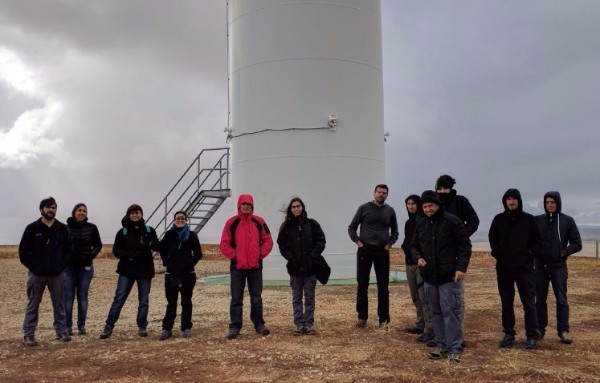
DTBird Team visits the wind farm where a new test program has started
DTBird team members recently visited a wind farm in Castilla y León (Spain) to follow the progress of a new test program involving two DTBirdV4D8 units. These units operate with the Collision Avoidance module D8, which includes eight speakers distributed at two heights: one below the lowest point reached by the blades, and another below the nacelle.
How the test setup works
Each unit has two sound configurations: sound-activated and muted. To compare performance, the configurations alternate every week, meaning that one unit broadcasts sound while the other remains muted. This switching pattern allows the team to study how the module behaves under different acoustic conditions.
Species monitored during the program
The wind farm is located in an area where several raptor species are commonly observed. The most frequent species recorded near the wind turbines include:
-
Gyps fulvus (Griffon vulture)
-
Milvus milvus (Red kite)
-
Buteo buteo (Common buzzard)
-
Falco spp.
These species provide valuable data because they often fly at rotor height and are relevant for evaluating collision avoidance systems.
Objectives of the study
The collected information will be used to conduct a species-specific evaluation of the DTBird Collision Avoidance module. This evaluation aims to:
-
assess detection performance,
-
analyze bird reactions to sound stimuli,
-
identify behavior patterns around active and inactive settings, and
-
support improvements to future module configurations.
Field visit and team activities
During the field visit, DTBird engineers inspected the installation of the units, reviewed sensor alignment, verified data transmission, and monitored bird activity on site. These validations are essential to ensure that the system is working correctly throughout the test period.
DTBird&DTBat Team wind farm visit in Castilla y León, Spain, 2017.